
What You Need to Know About Closed Terrarium Care
Closed terrarium care is simpler than most people expect — but only once you understand how the system actually works.
Here’s the quick version:
- Light: Bright, indirect light only. Never direct sun.
- Watering: Rarely — sometimes as little as once every 1-6 months. Watch condensation, not the calendar.
- Temperature: Keep it between 65-80°F (18-27°C). Avoid cold drafts and heat vents.
- Humidity: The jar manages this itself through its own mini water cycle.
- Venting: Open the lid for 20-30 minutes monthly to refresh air.
- Pruning: Trim plants when they touch the glass or crowd neighbors.
- Mold: Remove dead leaves immediately. Improve airflow if mold appears.
- Plants to use: Ferns, moss, fittonias, peperomias. Not succulents or cacti.
You sealed the lid. The glass fogged up. Then the leaves turned brown and something started to smell.
Sound familiar? You’re not alone — and it’s usually not because you did everything wrong. It’s because most guides hand you a recipe without explaining why each step matters.
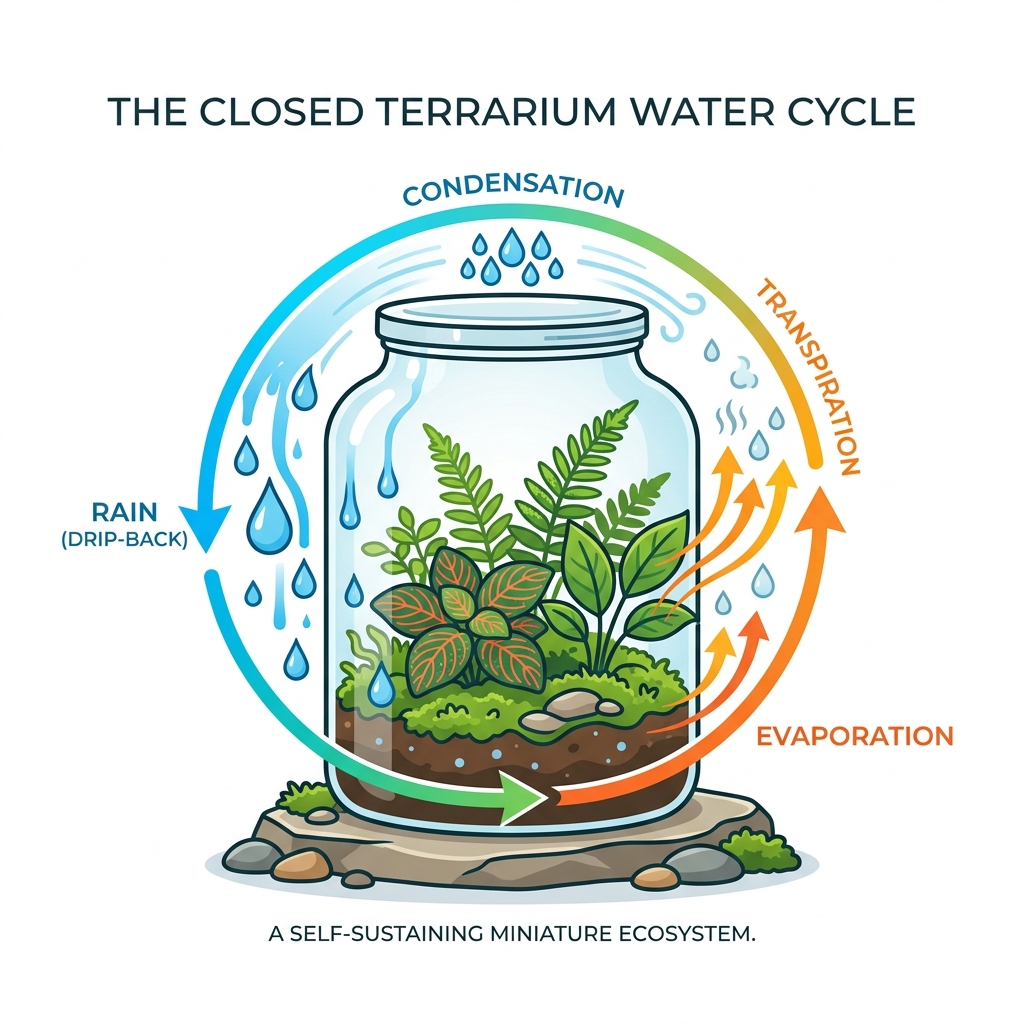
A closed terrarium isn’t just a plant in a jar. It’s a miniature ecosystem — one that runs its own water cycle. Water evaporates from the soil and plant leaves, condenses on the cooler glass walls, then drips back down like rain. When that cycle is balanced, the whole thing practically runs itself.
The oldest known sealed terrarium was watered just once — back in 1960 — and kept growing for decades. That’s the power of a well-balanced system.
This guide will show you exactly how to build and maintain that balance — from the first layer of gravel to the years of low-effort enjoyment that follow.
Setting the Foundation for Successful Closed Terrarium Care
Before we can master closed terrarium care, we have to ensure the “house” we build for our plants is structurally sound. Think of the jar as a tiny planet; if the crust and atmosphere aren’t right, the life inside won’t thrive.
According to research on Creating a Closed Terrarium, the most common mistake is ignoring the drainage layer. Since a closed jar has no holes at the bottom, any excess water has nowhere to go. Without a proper base, that water sits against the roots, leading to a “swamp effect” that causes rot.
We always recommend starting with a drainage layer of pea gravel or small stones. This creates a reservoir where excess water can sit safely away from the soil. While some designers treat this as a purely aesthetic choice, we see it as a functional necessity. If you are interested in the visual side of things, you might enjoy experimenting-with-layers-in-your-diy-succulent-terrarium to see how different materials can create beautiful patterns while still serving their purpose.
To keep your ecosystem healthy, you must use a sterile potting mix. Garden soil is far too heavy and often carries “hitchhikers” like pest eggs or fungi that will explode in the humid environment of a jar. We also use a soil separator—usually a piece of fine mesh or a layer of dried sphagnum moss—to prevent the soil from washing down into the rocks and clogging the drainage.
Essential Assembly Tools:
- Long-handled tweezers: For precise plant placement.
- A funnel: To add soil without dirtying the glass walls.
- A spray bottle: For gentle, controlled watering.
- A tamping tool: (Even a cork on a chopstick works!) to firm the soil around roots.
Essential Materials and Layering Techniques
The choice of your glass container dictates your future closed terrarium care routine. We prefer a wide-mouth jar for beginners because it makes pruning and cleaning significantly easier. A narrow-neck bottle looks magical, but it can be a nightmare to maintain when a leaf starts to rot in a corner you can’t reach.
When layering, aim for a substrate depth that provides enough room for the plants’ root balls without filling more than one-third of the jar. A good rule of thumb is the “1/3 to 2/3 ratio”—one-third of the jar is filled with soil and plants, and two-thirds is open air. This allows for proper gas exchange and room for the plants to grow. For those transitioning from other types of builds, our step-by-step-guide-diy-water-wise-succulent-terrarium offers great insights into substrate management, even if the plant needs differ.
The Critical Role of Activated Charcoal
If there is one “secret ingredient” in closed terrarium care, it is horticultural-grade activated charcoal. We never build a closed system without it.
Because the air and water are recycled within the jar, impurities can build up over time. Activated charcoal acts as a chemical filter. It absorbs toxins, prevents the growth of odor-causing bacteria, and keeps the water “sweet.” Without it, your terrarium might eventually start to smell like a stagnant pond or “forgotten vegetables.” A thin layer (about 1/4 inch) spread over the drainage rocks is all you need to keep the environment fresh.
Mastering Light and Temperature for Your Ecosystem
Light is the engine that drives your terrarium’s water cycle. Through photosynthesis, your plants turn light into energy, which in turn drives transpiration—the process where plants “sweat” water back into the air.
The golden rule of closed terrarium care is bright, indirect light. Think of the light found on a forest floor. An east-facing window is often the “sweet spot,” providing gentle morning sun without the scorching heat of the afternoon.
Never place a closed terrarium in direct sunlight. The glass acts like a magnifying glass, creating a greenhouse effect that can raise the internal temperature to over 100°F in minutes. We’ve seen healthy jars turn into “plant soup” in a single afternoon because they were left on a sunny porch. For more on general plant positioning, check out our indoor-succulent-care-tips-for-beginners.
Temperature stability is just as important. Most tropical terrarium plants thrive in the same range humans do: 65-80°F (18-27°C). Avoid placing your jar near radiators, air conditioners, or drafty windows, as rapid temperature swings can stress the plants and cause excessive condensation. Our indoor-succulent-humidity-and-temperature-guide provides a deeper look at how these factors interact in an indoor setting.
Light Level Comparison Table
| Light Condition | Plant Reaction | Required Action |
|---|---|---|
| Direct Sunlight | Scorched leaves, “cooked” appearance, heavy condensation | Move away from window immediately. |
| Bright Indirect | Vibrant colors, steady growth, light morning mist | Perfect! No action needed. |
| Medium Indirect | Slower growth, still healthy | Monitor for signs of stretching. |
| Low Light | “Leggy” or stretched stems, yellowing, mold growth | Move closer to a light source or add a grow light. |
Watering and Humidity: Reading Your Jar’s Language for Closed Terrarium Care
Learning to “read” your jar is the most rewarding part of closed terrarium care. Unlike a potted plant, you don’t water on a schedule; you water based on the visual cues of the ecosystem.
According to a publication on How to Design a Closed-System Terrarium, the goal is to reach a state of moisture equilibrium. In a perfectly balanced jar, you should see a light fog on the glass in the morning that clears up as the day warms. If the glass is bone-dry all day, the system needs a few sprays of water. If the glass is so foggy you can’t see the plants, or if water is constantly dripping down the sides, there is too much moisture.
When adding water, we always recommend using distilled water or collected rainwater. Tap water often contains minerals and chlorine that can build up on the glass (creating unsightly white streaks) and eventually harm sensitive mosses and ferns. Use a misting bottle to add water gradually; it is much easier to add a little more later than it is to remove excess water from the soil. Avoid common indoor-succulent-watering-mistakes-to-avoid like pouring water directly into the center of the jar.
Identifying Signs of Overwatering and Underwatering
It is vital to catch watering issues early. If you notice yellowing leaves or mushy stems, you are likely dealing with overwatering. This can lead to the dreaded root-rot-in-succulents-causes (which affects tropicals too!), where the roots literally suffocate from a lack of oxygen. If this happens, leave the lid off for a day or two to let the excess moisture evaporate. You can find more diagnostic tips at overwatered-succulents-diagnosis.
On the flip side, if your moss looks crispy and light-colored, or if the soil has pulled away from the edges of the jar, your terrarium is thirsty. Drooping foliage is a classic sign of underwatering, but in a closed system, it’s often the lack of condensation that tells the story first.
Long-Term Maintenance and Troubleshooting Common Issues in Closed Terrarium Care
A successful terrarium is a marathon, not a sprint. While these systems are low-maintenance, they aren’t “no-maintenance.” As your plants grow, they will eventually reach the top of the jar or begin to crowd their neighbors.
Growth regulation is key. We want our plants to grow slowly so they don’t outgrow their home in a few months. This is why we rarely use fertilizer. A closed terrarium is a low-nutrient environment by design. If, after a year or two, the plants look pale or stunted, you can add a very diluted organic liquid fertilizer (at 1/4 the recommended strength) during the spring.
Pruning, Cleaning, and Venting Rituals
We recommend a monthly “check-in” ritual. This involves:
- Pruning: Use long snips to trim back any leaves touching the glass. This prevents moisture from being trapped against the leaf, which can lead to rot.
- Cleaning: Wipe the inside and outside of the glass with a lint-free microfiber cloth. Keeping the glass clear ensures your plants get all the light they need for photosynthesis.
- Venting: Even if the moisture balance seems perfect, we like to open the lid for 20-30 minutes once a month. This refreshes the carbon dioxide levels and prevents the air from becoming stagnant.
For those just starting out, our guide on easy-diy-succulent-terrarium-for-beginners covers many of these basic maintenance habits that translate well to all types of indoor gardening.
Managing Mold, Pests, and Decay
Mold is the most common “villain” in closed terrarium care. It usually appears as white, fuzzy spots on decaying leaves or wood. If you spot it, don’t panic! Simply remove the affected leaf with tweezers. If the mold persists, you can dab the area with a Q-tip dipped in a 3% hydrogen peroxide solution.
For a more “hands-off” approach, many enthusiasts create a bioactive terrarium by adding springtails. These tiny, harmless insects act as a biological cleanup crew, eating mold spores and decaying matter before they can cause problems.
Frequently Asked Questions about Closed Terrarium Care
Can I grow succulents in a closed terrarium?
This is a question we get constantly at Opcion Rural. The short answer is: No.
While we love succulents, they are desert plants that require high airflow and low humidity. Placing them in a closed jar creates a “sauna” effect that leads to rapid rot. If you want to build a home for succulents, check out our guide on how-to-make-a-closed-diy-succulent-terrarium—but note that “closed” in that context usually refers to the style of the container, which must remain open at the top for airflow! Tropical plants are the true kings of the sealed jar.
How long can a well-maintained closed terrarium last?
With proper closed terrarium care, these ecosystems can last for years, or even decades. The most famous example is David Latimer’s terrarium, which was sealed in 1972 and is still thriving today. The key to such longevity is finding that perfect balance of light and moisture and then leaving it alone. Over-intervention is often more dangerous than neglect. If your jar starts to look “tired” after a few years, you can always refresh the design by replacing a single plant or adding new decorative stones.
Why is my moss turning brown?
Brown moss is usually a sign of one of three things:
- Too much light: The moss is being scorched by direct sun.
- Mineral buildup: You are using tap water, and the salts are “burning” the moss.
- Low humidity: The jar is too dry, and the moss is entering a dormant state.
Check your condensation levels first. If the glass is dry, add a few mists of distilled water. If the jar is in a sunny spot, move it to a more shaded area.
Conclusion
At Opcion Rural, we believe that closed terrarium care is more than just a hobby—it’s a way to reconnect with nature on a miniature scale. It taps into our “biophilia,” that innate human love for living things. By blending art, nature, and a bit of science, you can create a self-sustaining world that brings a sense of peace to your home or office.
Whether you are building your first “jar forest” or maintaining a decades-old ecosystem, observation is your best tool. Watch the mist on the glass, the color of the moss, and the pace of the growth. If you’re ready to start your next project, our guide-to-creating-a-self-sustaining-succulent-terrarium is a fantastic place to find inspiration for your next indoor garden adventure.
Happy planting, and may your little glass world thrive for years to come!
