
What Is a DIY Fake Moss Wall (And How Do You Make One)?
A diy fake moss wall is one of the easiest ways to bring lush, natural greenery into your home — no watering, no sunlight, no upkeep required.
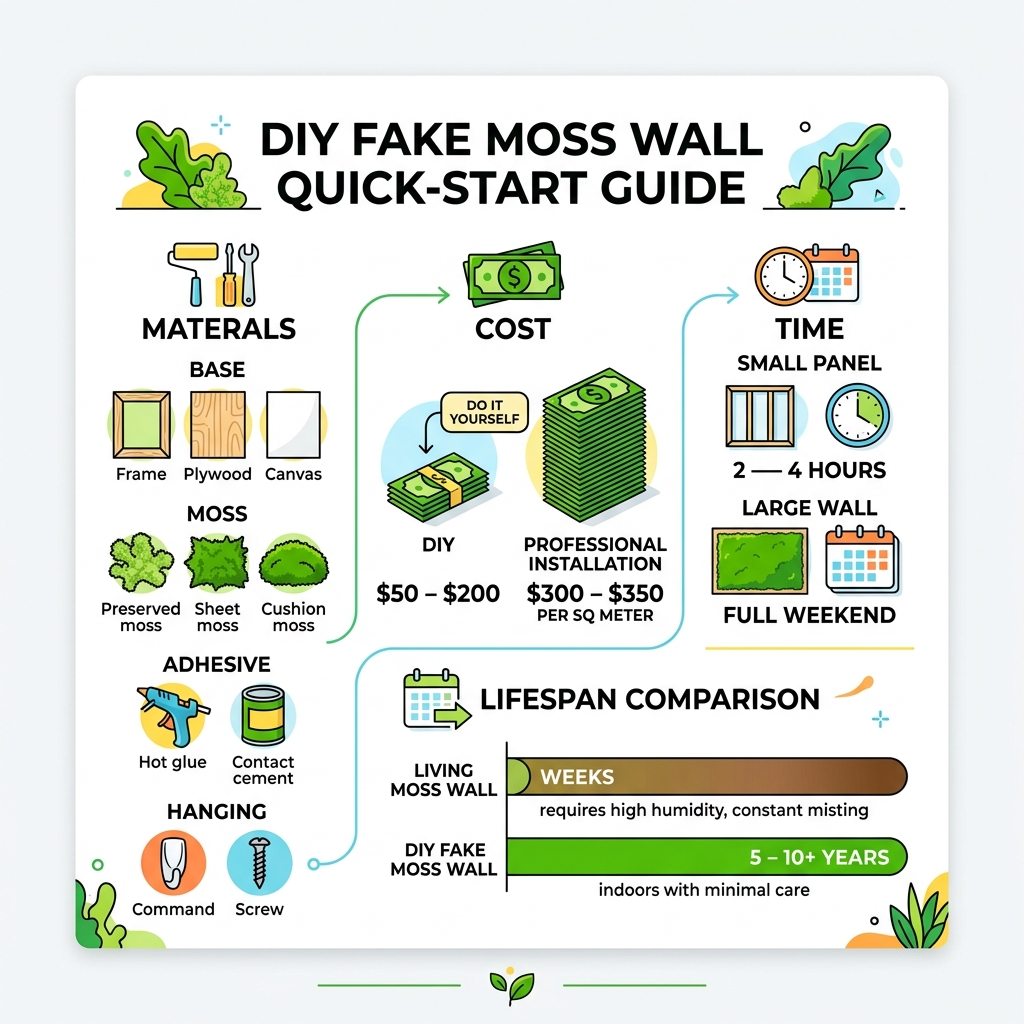
Here’s the quick version of how to make one:
- Choose your base — a wood frame, plywood panel, or canvas
- Pick your moss — preserved reindeer moss, sheet moss, or cushion moss work best
- Glue it down — use a hot glue gun or contact cement
- Layer for depth — mix moss types and colors for a natural look
- Hang it up — use Command hooks (renter-friendly) or screws for a permanent fix
Cost: Roughly $50–$200 DIY vs. $300–$350 per square meter for professional installation. Time: 2–4 hours for a small panel; larger walls may take a full weekend. Lifespan: 5–10+ years indoors with minimal care.
Moss walls have exploded in popularity — and it’s easy to see why. They’re bold, textural, and completely maintenance-free. Unlike a living plant wall, preserved or artificial moss doesn’t need humidity, fertilizer, or any attention at all. It just looks alive.
The best part? You don’t need to be an artist or a professional to make one. With a bag of preserved reindeer moss, a hot glue gun, and a spare afternoon, you can create something that genuinely stops people in their tracks.
Whether you want a small framed piece for a reading nook or a large feature wall in your living room, this guide walks you through every step — from choosing materials to hanging the finished piece safely.
Why Choose a DIY Fake Moss Wall?
When we think about interior design, we often look for that “wow” factor that connects us back to nature. This is known as biophilic design. However, keeping real moss alive indoors is a Herculean task. Real moss requires nearly 80% humidity and constant misting. Without a specialized, self-watering irrigation system, a living moss wall in a typical home will turn into a brown, crunchy mess within weeks.
By choosing a diy fake moss wall, we get the aesthetic brilliance of a vertical forest without the risk of mold, water damage to our drywall, or the heartbreak of dying plants. It is the ultimate “set it and forget it” decor.
The Benefits of Preserved and Artificial Greenery
There is a slight difference between “fake” and “preserved” moss that we should clarify. Most high-end DIY projects use preserved moss. This is real moss that has had its water content replaced by a mixture of glycerol and natural dyes. This process “mummifies” the moss, keeping it soft, flexible, and vibrantly green for years.
The benefits are numerous:
- Zero Maintenance: You never have to water it. In fact, watering it will actually ruin the dye and the preservative.
- Acoustic Benefits: Moss is an incredible natural sound absorber. A large moss wall can dampen high-frequency reflections, making a “clippy” or echoey room feel much softer and quieter.
- Durability: If you choose purely synthetic options, such as PE material, the wall becomes even more durable and can often be UV-rated to prevent fading.
- Hypoallergenic: Unlike some living plants that produce pollen or harbor soil gnats, preserved moss is clean and generally hypoallergenic.
Cost Comparison: Professional vs. DIY
One of the biggest drivers for the DIY route is the sheer savings. According to our research, a professional moss wall installation can cost between €300 and €350 per square meter. For a standard 5 m² feature wall, you are looking at an investment of over €1,500.
In contrast, doing it yourself costs approximately €120 per square meter. On that same 5 m² wall, we can save at least €900! Even for smaller projects, like a set of three 12 x 12-inch frames, the cost is significantly lower than buying pre-made “moss art” from high-end boutiques, which can retail for $98 or more per piece.
Essential Materials for Your DIY Fake Moss Wall
Before we get our hands sticky, we need to gather our supplies. Having everything ready on your workbench prevents that mid-project panic when you realize you’ve run out of moss or glue.
Choosing the Best Moss for Your DIY Fake Moss Wall
For a realistic, professional look, don’t just stick to one type of moss. Nature is messy and diverse, and your wall should be too. We recommend a mix of the following:
- Green Reindeer Moss: This is the “puffy” stuff. It comes in clumps and adds incredible 3D texture. You will need about 4–8 kg per square meter depending on how densely you pack it.
- Preserved Sheet Moss: Think of this as your “carpet.” It’s flat and great for covering large areas of the backing board quickly.
- Natural Reindeer Moss: Use this to provide color contrast. Mixing dark green reindeer moss with lighter shades like Chartreuse creates a sense of life and growth.
- Cushion or Mood Moss: These are thick, velvety mounds that look like little hills. They are perfect for creating focal points.
Selecting the Right Adhesives and Tools
The glue is the only thing standing between your beautiful art and a pile of moss on the floor.
- Hot Glue Gun and Glue sticks: This is the fastest method. It bonds almost instantly, which is vital when working on vertical surfaces.
- Contact Cement (e.g., Bison Glue): For very large walls, some pros prefer contact glue. You apply it to both the moss and the wall, let it get tacky, and then press.
- Nitrile gloves: Preserved moss is dyed, and that dye will transfer to your hands. Unless you want to look like Shrek for a week, wear gloves.
- Power drill: Essential for mounting your frame or panels to the wall.
- Floral Pins: These are “U” shaped pins that help hold heavy clumps of moss in place while the glue sets.
Step-by-Step Guide to Building Your Moss Masterpiece
Now for the fun part! We are going to build a framed moss wall art piece. This technique can be scaled up for a full wall, but starting with a frame is the best way for beginners to learn the “60/30/10” design rule.
Preparing the Base and Frame
You can’t just glue moss to a bare wall (well, you can, but it’s messy and permanent). We need a sturdy base.
- The Frame: We love using 12 x 12 Wood Panels or even repurposed Wood trays. If your frame is raw wood, give it a quick sand.
- Staining: To give it a high-end look, use a stain like Varathane Less Mess Wood Stain (Dark Walnut). It has a sponge tip applicator that makes the job incredibly easy.
- The Backing: If your frame is deep, you might want to fill the bottom with Neoprene foam or pink insulation foam. This saves you from using massive amounts of expensive moss to fill the depth.
- Mounting Hardware: Always attach your French cleat or hanging wire before you add the moss. Trust us, trying to hammer a bracket onto the back of a finished moss piece is a recipe for a “moss-tastrophe.”
Step-by-Step Assembly of Your DIY Fake Moss Wall
Step 1: Visualize the Design Don’t start gluing yet! Lay your frame flat on a table and arrange your moss. Follow the 60/30/10 rule: 60% base moss (sheet moss), 30% texture (reindeer moss), and 10% accents (mood moss, wood, or stones).
Step 2: Apply the Base Layer Start with your preserved sheet moss. Tear it into manageable chunks. Apply Hot Glue to the base and press the moss down firmly.
Step 3: Add the Texture Now, take your Green Reindeer Moss. A pro tip we’ve learned: tear the reindeer moss into smaller tufts. If you use giant clumps, you’ll run out of material quickly and leave gaps. Glue these tufts tightly together to hide the backing.
Step 4: The Wiggle Test Once the glue has dried (usually after 10–15 minutes), gently wiggle the moss with your fingers. If anything feels loose, add a dab of Superglue or hot glue to secure it.
Step 5: Finishing Touches Fill any tiny “black holes” or gaps with small bits of moss. If you’re feeling fancy, glue in a few Pole Preserved moss pieces to act as “hills” in your landscape.
| Base Material | Pros | Cons |
|---|---|---|
| Plywood | Very sturdy, cheap | Heavy, needs power tools |
| Pink Insulation | Lightweight, easy to pin | Can be fragile if not framed |
| Canvas | Easy to find, lightweight | Can sag if the moss is too heavy |
Design Tips for a Realistic and Professional Look
If you want your diy fake moss wall to look like it was installed by a boutique design firm, you need to think about more than just green fluff.
Creating Depth with Different Moss Types
In the wild, moss doesn’t grow in a flat, uniform sheet. It grows over rocks, around roots, and in varying shades of green.
- Hardscape Integration: Incorporate natural elements. A piece of driftwood or “spiderwood” adds an immediate sense of scale and realism. You can even use Jute twine to “tie” moss to branches for a hanging look.
- Tearing vs. Cutting: Never use Scissors to cut your moss into perfect squares. Always tear it by hand. The ragged edges blend together much more naturally than straight lines.
- Color Psychology: Use darker mosses in the “valleys” and lighter, chartreuse mosses on the “peaks.” This mimics how light hits a natural forest floor.
Professional Finishing Touches
- Check Your Angles: Look at your wall from the side. Can you see the glue? Can you see the foam backing? If so, pack more moss in there.
- Lighting: To really make your moss pop, use soft wall-wash lighting. Aim for a color temperature of 3000K–3500K. This warm light enhances the greens without making the moss look “neon” or plastic.
- Silicone bumpers: If you are hanging a frame, add small silicone bumpers to the bottom corners. This allows air to circulate behind the frame and prevents the wood from scratching your wall.
Installation and Long-Term Care
Once your masterpiece is complete, it’s time to show it off.
Hanging Options:
- Permanent: Use a Power drill and screws to mount a French cleat. This is the most secure method for large, heavy panels.
- Rent-Friendly: For smaller frames, these hooks or heavy-duty Command strips work wonders. Just ensure the wall is clean and dry before applying the adhesive.
Maintenance: The beauty of a fake moss wall is the lack of work, but it isn’t completely maintenance-free.
- Dusting: Every few months, use an anti-static duster or a hair dryer on the “cool” and “low” setting to blow off any dust.
- Sunlight: Keep your moss wall out of direct sunlight. Even though it’s preserved, UV rays will eventually fade the natural dyes, turning your lush green wall into a pale yellow one.
- Humidity: Avoid placing your moss wall in a bathroom with a shower or directly next to a heater. Extreme humidity can cause the dye to “bleed,” and extreme heat can make the moss brittle.
Frequently Asked Questions about DIY Fake Moss Walls
How long does a fake moss wall last?
In a stable indoor environment, a preserved moss wall can last anywhere from 5 to 10 years. Over time, the color might soften, but you can always how to touch up moss by gluing new tufts over any faded areas.
Can I install a moss wall outdoors?
Generally, no. Preserved moss is for indoor use only because rain will wash away the dyes and preservatives. However, if you use purely synthetic PE material panels that are UV-rated, you can absolutely create an outdoor “green wall.”
Is a fake moss wall safe for pets?
Yes, most preserved moss is treated with non-toxic, food-grade dyes and glycerol. However, some pets (especially cats) might find the texture tempting to chew on. We recommend mounting your moss art at a height that is out of reach of curious paws.
Conclusion
At Opcion Rural, we believe that bringing nature indoors shouldn’t be a chore. Creating a diy fake moss wall is the perfect weekend project to bridge the gap between art and ecology. It’s a creative outlet that rewards you with a stunning, tactile piece of decor that lives on your wall for years to come.
Ready to start your own biophilic journey? Grab your Hot Glue gun and some Preserved Sheet Moss, and let your creativity grow! For more inspiration on nature-inspired home builds, check out Rooted in Design or explore more of our DIY projects.
Your Final Checklist:
- [ ] Frame stained and prepped?
- [ ] Hanging hardware attached?
- [ ] 60/30/10 design planned?
- [ ] Nitrile gloves on?
- [ ] Moss securely “wiggle-tested”?
Happy crafting!
