
What Is Burro Tail Propagation (and How Does It Work)?
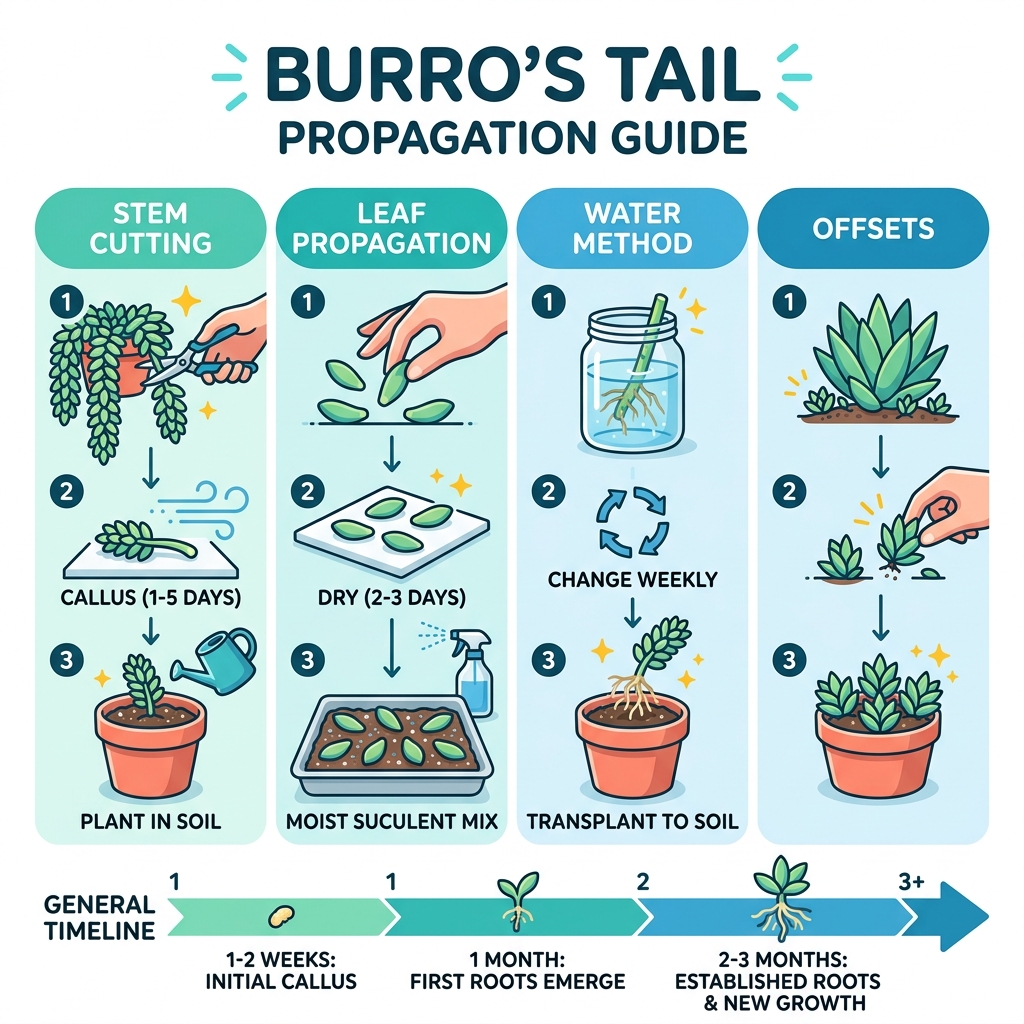
Burro tail propagation is the process of growing new Burro’s Tail succulents from stem cuttings, individual leaves, or offsets. Here’s a quick overview:
- Stem cuttings – Cut a healthy stem (at least 5 cm), let it callus for 1-5 days, then plant in well-draining soil
- Leaf cuttings – Gently remove plump leaves, let them dry 2-3 days, then lay on moist succulent mix
- Water propagation – Place a prepared stem cutting in water, change it weekly, transplant once roots reach 1-2 inches
- Offsets – Separate small “pup” plants growing at the base and repot in well-draining soil
Most methods take 2-3 months to fully root and establish.
Burro’s Tail is one of those plants that practically wants to be propagated. Its long, cascading stems are lined with plump, blue-green leaves that detach at the slightest touch — a natural survival mechanism the plant uses to spread itself in the wild.
That fragility can feel frustrating at first. But once you understand it, it becomes a gift. Every leaf that drops is a potential new plant.
This trailing succulent can eventually grow up to 4 feet long — though that takes around six years. Propagation lets you fast-track your collection, fill out hanging baskets, or share plants with friends, all without spending a cent.
Whether you have a single pot on a windowsill or a wall of shelves, this guide will walk you through every method, step by step.
Why and When to Start Your Burro Tail Propagation Project
At Opcion Rural, we believe that understanding the rhythm of your plants is the first step to a thriving home ecosystem. While you can technically propagate succulents year-round indoors, timing your burro tail propagation project with the plant’s natural growth cycle yields much faster results.
The optimal time to start is during the late spring or early summer. This is when the plant enters its active growth phase. During these months, the warmer temperatures and increased light levels provide the energy needed for cuttings to push out new roots quickly. We’ve found that the “sweet spot” for temperature is between 60°F and 75°F (15°C to 24°C). If you live in a particularly hot climate, like the desert, you might find that your cuttings callus over in just a single day, whereas in cooler, humid areas, it might take nearly a week.
Why bother propagating? Aside from the joy of creating “plant babies,” Burro’s Tail (also known as Donkey’s Tail) has a specific growth habit. Over time, the stems can grow to nearly a meter long—some even reach 4 to 6 feet after about six years! However, as the plant ages, the top of the stems near the soil often becomes bare. By learning How to Identify Succulent Types, you’ll realize that this Sedum morganianum doesn’t grow leaves back on bare stems. Propagation allows you to take those long, leggy stems and turn them into a brand-new, lush, full pot.
Essential Methods for Burro Tail Propagation
There isn’t just one way to multiply your Burro’s Tail. Depending on your patience level and the material you have available, you can choose from four primary methods. We like to think of these as the “choose your own adventure” of the succulent world.
- Stem Cuttings: This is widely considered the most efficient method. You get a “head start” because you’re beginning with a significant piece of the plant.
- Leaf Cuttings: This is the most magical method, though it requires the most patience. It’s perfect for those dozens of leaves that inevitably fall off whenever you move the mother plant.
- Water Propagation: An interesting, visual method that allows you to watch the roots grow through glass. It’s great for beginners who want to ensure roots are actually forming.
- Offsets: Sometimes called “pups” or “chicks,” these are smaller versions of the parent plant that grow near the base.
If you’re working inside, be sure to check our guide on How to Propagate Succulents Indoors for environment-specific tips.
Soil vs. Water Propagation: Which is Better?
| Feature | Soil Propagation | Water Propagation |
|---|---|---|
| Success Rate | High (less risk of rot if calloused) | Moderate (requires frequent water changes) |
| Speed | 4-6 weeks for roots | 2-3 weeks for roots |
| Ease | Set it and forget it | Requires monitoring for murkiness |
| Transplant Shock | Low | Moderate (roots must adapt to soil) |

Step-by-Step: Propagating from Stem Cuttings
Propagating from stems is the best way to fill a new pot quickly. We recommend using stems that are at least 5 cm (about 2 inches) long, though many enthusiasts prefer 4-6 inch segments for a more established look.
The first step is always the hardest: making the cut. Use a clean, sharp pair of shears. Once you have your cutting, you must remove the leaves from the bottom one-third of the stem. This “bare” section of the stem is where the new roots will emerge.
Crucially, you cannot plant the stem immediately. You must allow the cut end to callus over. This takes anywhere from 24 to 48 hours, though some experts suggest waiting up to 5 days to ensure the wound is completely dry. If you plant a “wet” wound into moist soil, you are inviting bacteria and rot to the party—and that’s a party no one wants to attend.
Preparing Your Burro Tail Propagation Cuttings
To ensure a high success rate, we use a few “pro tips” during the preparation phase. First, when you prune, try to cut just below a leaf node. This is where the plant’s growth cells are most concentrated. If you’re nervous about rot, you can dip the calloused end in a bit of antifungal cinnamon powder or a commercial rooting hormone.
While you wait for your stems to heal, it’s a great time to learn How to Prune Indoor Succulents to keep your mother plant looking tidy after you’ve taken your cuttings. The mother plant will often sprout two new stems from the point where you made your cut, eventually leading to a fuller, bushier plant.
Planting and Initial Care for Stems
Once calloused, it’s time to plant. Choosing the Best Soil for Indoor Succulents is vital. We recommend a well-draining mix: one part sand, 1.5 parts perlite, and 1.5 parts potting soil.
- Poke a hole: Use a chopstick or pencil to create a hole in the dry soil. This prevents the delicate stem from being damaged as you push it in.
- Anchor the stem: Burro’s Tail stems are heavy and “juicy.” They tend to fall out of the pot before they root. Use floral pins (small U-shaped wires) to pin the stem to the soil.
- The “No-Water” Week: This is the most common mistake. Do not water your cutting for the first week. The succulent has plenty of water stored in its leaves to survive.
- Light: Provide bright, indirect light. Avoid direct afternoon sun, which can scorch the young cutting.
After the first week, follow a strict Indoor Succulent Watering Schedule. Generally, you’ll want to water once a week, ensuring the soil dries out completely between sessions. Expect to see established roots in 4 to 6 weeks.
The Magic of Burro Tail Propagation from Leaves
There is something truly captivating about watching a tiny, microscopic plantlet emerge from the base of a single leaf. Because Burro’s Tail leaves are so fragile, you will likely have plenty of “volunteers” to work with.
For successful burro tail propagation from leaves, you must ensure the leaf is whole. The meristematic cells required to grow a new plant are located exactly where the leaf attaches to the stem. If the leaf snaps in the middle, it won’t grow a new plant.
Gently twist a plump leaf off the stem (or collect the ones that fell during repotting). Like the stems, these leaves need to callus for 2 to 3 days on a dry tray.
Setting Up Your Leaf Propagation Station
We like to use a shallow tray for leaf propagation. Fill it with a layer of succulent mix and simply lay the leaves on top. You don’t need to bury them; in nature, they just sit on the soil surface.
Keep the tray in a warm spot (around 75°F) with bright, filtered light. During the first two weeks, you can mist the soil surface every 2-3 days to provide a hint of humidity. Soon, you’ll see tiny pink or white roots searching for the soil.
As the new plantlet grows, the “mother leaf” will slowly shrivel up. Don’t pull it off! It is providing all the nutrients and water the baby plant needs. Once the mother leaf is a crispy husk, it will fall off on its own. This whole process typically takes 2 to 3 months. For more on caring for these tiny babies, see our Indoor Succulent Care Tips for Beginners.
Troubleshooting Common Propagation Problems
Even the most experienced succulent lovers run into trouble. Here are the “Red Flags” to watch for:
- Root Rot: If the base of your stem turns black, greasy, or mushy, it’s rot. This is usually caused by overwatering or not letting the cutting callus properly. To fix it, prune away the affected tissue with clean tools and start the callousing process over.
- Leaf Drop: If your established propagation is dropping leaves at the slightest touch, it might be overwatered. If the leaves look yellow and translucent, that’s a definite sign of too much water.
- Etiolation: If your new stems are stretching out with wide gaps between the leaves, they aren’t getting enough light. Move them to a brighter spot, but do it gradually to avoid sun stress.
- Pests: Mealybugs (tiny white cottony spots) love succulents. Dab them with a cotton swab soaked in isopropyl alcohol to get rid of them quickly.
- Farina Loss: Have you noticed a silvery, waxy powder on the leaves? That’s farina. It’s a natural sunscreen and water repellent. Try not to touch the leaves too much, as the oils from your fingers will rub it off, leaving the plant vulnerable to sunburn.
For more help, check out our list of Beginner Mistakes in Succulent Care to ensure your home ecosystem stays healthy.
Frequently Asked Questions about Burro Tail Propagation
How long does it take for Burro’s Tail to root?
Typically, you will see roots on stem cuttings within 4 to 6 weeks. However, it takes about 2 months for the plant to be fully “established” in its new pot. Leaf propagation is slower, usually taking 2 to 3 months before you have a recognizable mini-plant. Patience is your best friend here!
Can I propagate Burro’s Tail in water?
Yes! This is often called the hydroponic method. Take a 4-inch stem cutting, remove the bottom leaves, and let it callus for 2 days. Place the stem in a glass of filtered water (submerging only the bare stem). Change the water weekly to keep it oxygenated. Once the roots are 1 to 2 inches long, you can transplant it into soil.
Why are my propagation leaves turning yellow?
Yellow, mushy leaves are almost always a sign of overwatering. If the leaves are turning yellow and the stem feels soft, you likely have root rot. If the leaves are pale yellow and the plant is stretching, it likely needs more light. For a deep dive into recovery, read our guide on Repotting Indoor Succulents Step-by-Step.
Conclusion
At Opcion Rural, we believe that bringing nature into your home should be an act of creativity and joy. Burro tail propagation is the perfect project for anyone looking to build their own accessible home ecosystem. It teaches us patience, the importance of environment, and the incredible resilience of nature.
Whether you are starting with a single leaf or a 16-inch stem cutting, remember to be gentle. These plants are delicate, but they are also survivors. With the right soil, a bit of light, and the “leave it alone” attitude that succulents love, you’ll soon have a cascading curtain of green to call your own.
Ready to expand your indoor garden even further? Check out The Beginner’s Guide to Easy Indoor Succulents for more inspiration on your plant journey!
