
The Simple Secret to a Thriving Succulent Terrarium
Succulent terrarium layers are the key to keeping your mini desert garden alive and healthy — especially in glass containers with no drainage holes.
Here’s a quick overview of the 5 essential layers, in order from bottom to top:
- Drainage layer — 1 to 2 inches of pebbles, gravel, or river rock to collect excess water
- Activated charcoal layer — 1/4 to 1/2 inch to filter toxins and prevent mold and odors
- Barrier layer — a thin layer of sphagnum moss or mesh to stop soil from mixing into the drainage
- Soil layer — 2 inches of well-draining cactus or succulent mix for roots and nutrients
- Decorative top layer — sand, small stones, or moss for a finished, natural look
Building a succulent terrarium is one of the most satisfying small-space DIY projects you can do. You get a living piece of art that fits on a windowsill, a desk, or a dining table — and it practically takes care of itself once it’s set up right.
But here’s the catch: get the layers wrong, and your succulents will slowly drown. Succulents hate soggy roots. Without proper drainage built into the container itself, water has nowhere to go.
The good news? Once you understand what each layer does and why it matters, building one is straightforward and fun. This guide walks you through every layer, every material, and every step — so your tiny desert landscape thrives for years.

Understanding the Science of Succulent Terrarium Layers
To build a successful terrarium, we have to think like a hydrologist. In nature, succulents live in arid environments where water drains through sandy, rocky soil almost instantly. When we put these plants in a glass bowl, we are essentially creating a “closed-bottom” system. Without a way for water to exit, we must create a space for it to sit safely away from the roots.
This is where the drainage mechanics come into play. By experimenting with layers in your DIY succulent terrarium, we create a “false bottom.” This reservoir allows gravity to pull excess moisture down past the root zone, preventing the dreaded root rot. Scientific research shows that a properly layered system can reduce root-rot incidence by up to 45% compared to unlayered containers.
Another critical scientific component is the prevention of anaerobic zones. When soil stays wet for too long without oxygen, “bad” bacteria take over, leading to a swampy smell and decaying plants. This is why we use an open system for succulents. Unlike tropical terrariums that are closed to trap humidity, succulent terrariums need airflow to keep the environment dry.
The inclusion of Activated charcoal filtration properties is a game-changer for these mini-ecosystems. Activated charcoal is highly porous and acts like a chemical sponge. It has a 90% filtration efficiency for adsorbing toxins, salts, and organic leachates that can build up in the water reservoir over time. It keeps the air inside the glass fresh and prevents the growth of mold and mildew.
Essential Materials for Your Arid Mini-Garden
Before we start stacking, we need to gather our supplies. Part of the fun at Opcion Rural is building a small ecosystem DIY succulent terrarium using materials that are both functional and beautiful.
- Glass Vessels: Look for wide-mouthed bowls, jars, or geometric containers. Clear glass is best so you can admire your succulent terrarium layers.
- River Rocks and Pea Gravel: These form our foundation. You can use colorful aquarium gravel or natural river stones.
- Activated Charcoal: Ensure you get “horticultural” or “aquarium grade” charcoal, which comes in small chunks rather than a fine powder.
- Sphagnum Moss: This is a “super material.” Sphagnum moss can hold 10x its weight in water! It acts as a sponge and a filter.
- Cactus and Succulent Soil: Never use standard garden soil. You need a mix heavy in perlite, pumice, or coarse sand to ensure rapid drainage.
- Decorative Elements: This is where you add personality with non-reactive stones, driftwood, or even small figurines.
If you are on a budget, you can find affordable alternatives for many of these. Cleaned beach pebbles or gravel from a hardware store work just as well as expensive boutique stones. For more details on choosing the right components, check out our cactus terrarium DIY everything you need to know guide.
Step-by-Step Guide to Building Your Terrarium
Now, let’s get our hands dirty. Building the layers is like building a house; you need a solid foundation before you can put up the walls and decor.
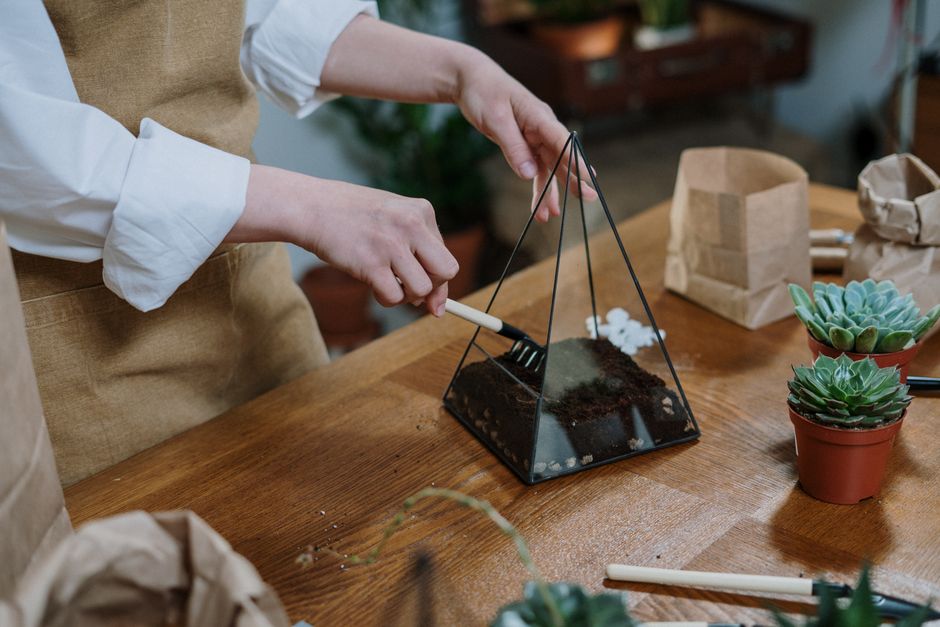
- The Base Drainage: Start by adding 1 to 2 inches of pebbles or river rocks. For smaller containers, aim for about 10-15% of the total height. Level this layer by gently tapping the side of the glass.
- The Charcoal Filter: Sprinkle a 1/4 to 1/2 inch layer of activated charcoal over the rocks. It doesn’t need to be thick, just enough to cover the surface.
- The Barrier Layer: Place a thin layer of dried sphagnum moss or a piece of fine mesh over the charcoal. This is the “security guard” layer that prevents soil from sifting down and clogging your drainage rocks.
- The Soil Mound: Add about 2 inches of succulent potting mix. Don’t just flatten it; try mounding the soil higher in the back to create “hills and valleys” for visual interest.
- Planting: Dig small divots for your succulents. Start with the largest plant (the “thriller”) and fill in with smaller varieties.
Layer Thickness Comparison Table
| Container Size | Drainage Layer | Charcoal Layer | Soil Layer |
|---|---|---|---|
| Small (Jar/Small Bowl) | 1/2 – 1 inch | 1/4 inch | 1 – 1.5 inches |
| Medium (6-8″ Bowl) | 1.5 inches | 1/2 inch | 2 – 2.5 inches |
| Large (10″+ Basin) | 2 – 3 inches | 1/2 – 1 inch | 3+ inches |
For a more detailed walkthrough, see our step-by-step guide DIY water-wise succulent terrarium.
The Role of Drainage in Succulent Terrarium Layers
We cannot overstate the importance of the pebble base. Because glass containers lack holes, the drainage layer acts as a safety net. If you accidentally add too much water, it trickles down between the rocks.
When turning glass containers into DIY succulent terrariums, the air pockets between the stones also help with root aeration. Roots need to breathe! If they are submerged in water-logged soil, they suffocate and rot. By maintaining a drainage layer that is roughly 1/8 to 1/4 of the container’s height, you ensure your plants stay high and dry.
Optimizing the Soil and Barrier Succulent Terrarium Layers
The soil layer is the “pantry” for your plants, providing the nutrients they need. However, succulents are light eaters. A high-quality cactus mix amended with perlite or pumice is essential. If you want to make your own, a common ratio is 3 parts potting soil, 1 part perlite, and 1 part coarse sand.
The barrier layer is the most overlooked part of succulent terrarium layers. If soil particles wash down into the rocks, the drainage layer becomes a muddy mess, defeating its entire purpose. Using sphagnum moss is a great choice because it has antibacterial properties that keep the substrate from degrading. Alternatively, a piece of landscape fabric or fine window screen works perfectly to keep the layers distinct and clean. This attention to detail is what separates a long-lasting mini desert DIY succulent terrarium from one that fails in a month.
Planting, Maintenance, and Troubleshooting
Once the layers are in place, it’s time to plant. We recommend choosing succulents with similar light and water needs. Varieties like Echeveria, Haworthia (Zebra Plant), and Crassula (Jade) are excellent for beginners because they grow slowly and stay compact.
When planting, leave at least an inch of space between each plant to allow for growth and airflow. After you’ve tucked them in, use a soft brush or a straw to blow away any soil that landed on the leaves. Place your finished masterpiece in a spot with bright, indirect light. Direct afternoon sun through glass can actually “cook” your plants!
To beautify your workspace with a DIY succulent terrarium, you must master the “soak and dry” watering method. Since there is no drainage hole, you must be precise. Use a squeeze bottle or a small measuring cup to water the soil directly at the base of the plants. Wait until the soil is bone-dry all the way through before watering again—usually every 2 to 4 weeks.
Why is my succulent turning yellow?
Yellow, mushy leaves are the classic “crying for help” sign of overwatering. This usually means the drainage layer has filled up or the soil is too dense. If you see this, stop watering immediately and move the terrarium to a brighter, warmer spot to help it dry out. If the stem is black or soft, you may need to perform “surgery” by removing the rotting plant before it infects the others.
How often should I water a terrarium without holes?
There is no “one size fits all” schedule. In the summer, your terrarium might need water every 2 weeks. In the winter, when succulents go dormant, it might only need a sip every 6 weeks. Always check the soil with a wooden skewer or your finger first. If it feels even slightly damp, leave it alone!
Can I use regular potting soil for succulents?
We strongly advise against it. Regular potting soil is designed to hold onto moisture—the exact opposite of what a succulent wants. It also tends to compact over time, squeezing the life out of delicate roots. If you only have regular soil, you must amend it with at least 50% grit (perlite, pumice, or coarse sand) to make it suitable for succulent terrarium layers.
Conclusion
At Opcion Rural, we believe that anyone can bring a bit of the natural world indoors. By understanding the function of each of the succulent terrarium layers, you aren’t just making a decoration; you are building a sustainable, tiny ecosystem.
Whether you are looking to create a statement piece for your coffee table or a thoughtful handmade gift, the key is patience and proper layering. Remember: drainage is your best friend, and overwatering is your only real enemy.
Ready to get started? Start your next project with Opcion Rural and explore our other guides on creative gardening and rural-inspired DIYs. Happy planting!
