
The Easiest Way to Add Lush Greenery to Your Walls (No Watering Required)
DIY faux plant wall art is one of the fastest-growing home decor trends for good reason — it brings the calming, natural feel of a living green wall into any space, with zero plant care involved.
Here’s how to make faux plant wall art at home:
- Choose your format — a small succulent frame, a pegboard panel, or a full accent wall
- Gather materials — artificial succulents or greenery panels, a wood frame or backing, and a hot glue gun or wire
- Arrange your plants — work from corners outward, mixing textures and shades for a natural look
- Secure everything — glue, pipe cleaners, or zip ties depending on your method
- Hang it up — use D-ring hangers, Command strips, or wall screws based on your setup
Costs range from as little as $20 using Dollar Tree supplies, up to $50–$200 for a larger panel wall. Compare that to $399 for a ready-made version from a high-end retailer — the savings are hard to ignore.
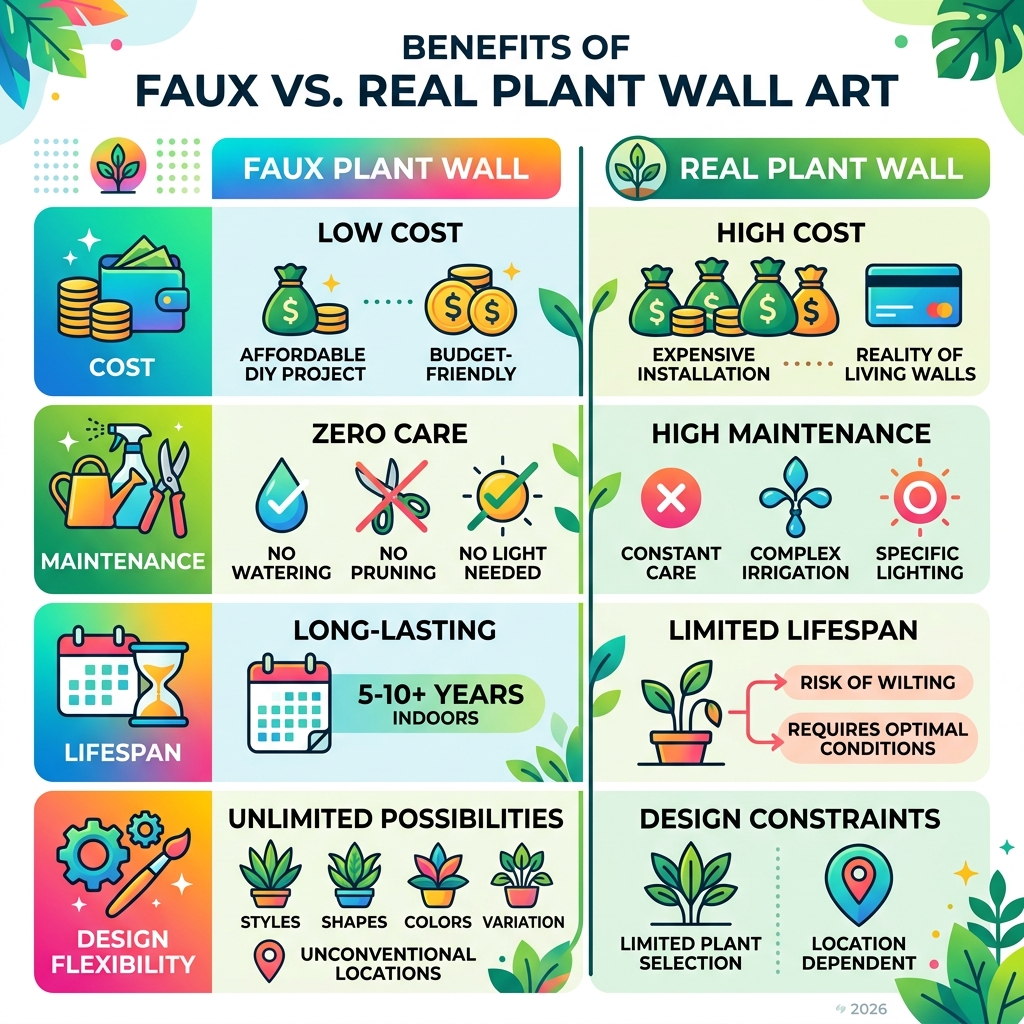
The appeal goes beyond the budget. Faux plant walls work in small apartments, home offices, and rooms with no natural light. They last 5–10+ years indoors, never wilt, and never need watering. For anyone who loves the look of greenery but struggles to keep real plants alive, it’s the perfect creative outlet.
Whether you want a single framed succulent display or a floor-to-ceiling botanical statement wall, the methods below will walk you through exactly how to build it.
Why Choose DIY Faux Plant Wall Art?
We all love the look of a lush, vertical garden, but the reality of maintaining living walls can be a nightmare. Real living walls require complex irrigation systems, specific lighting conditions, and constant pruning. By choosing diy faux plant wall art, we get all the aesthetic benefits of biophilic design—the practice of connecting our indoor spaces to nature—without the stress of a “plant graveyard” on our walls.
Massive Cost Savings
One of the biggest drivers for this project is the price tag of high-end retail versions. For instance, the Pottery Barn succulent wall art is absolutely stunning, but the large version costs a staggering $399. By sourcing our own materials, we can create a nearly identical “dupe” for a fraction of that cost. Research shows that a DIY faux greenery wall typically costs between $50 and $200 depending on the square footage, making it accessible for almost any budget.
Durability and Longevity
Unlike real plants that can wither in a few months if neglected, high-quality artificial plants are built to last. Many modern faux plants are made from polyethylene (PE), a durable material that gives the leaves a realistic, waxy feel. When kept indoors, these installations have a lifespan of 5 to 10+ years.
Sound Dampening and Aesthetics
Beyond just looking pretty, a full-scale faux plant wall actually serves a functional purpose. The density of the foliage helps dampen sound, making it a brilliant addition to a noisy home office or a dining room with hard surfaces. It’s an easy way to hide wall imperfections or outdated wallpaper while creating a “wow-factor” focal point.

Essential Materials and Tools for Your Project
Before we dive into the construction, let’s get our workstation ready. The materials you choose will depend on whether you are making a small framed piece or a massive accent wall.
The Greenery
- Artificial Succulents: Look for assorted packs to get a variety of shapes and colors. For a 14×18 inch board, you’ll need about 42 individual succulents to achieve a full, high-end look.
- Boxwood or Ivy Panels: These usually come in 20×20 inch squares. They are perfect for larger projects because they often feature a built-in grid backing that makes attaching extra stems a breeze.
- Felt: If you’re feeling extra crafty, you can even hand-make succulents out of felt for a soft, “cozy nature” aesthetic.
The Tools of the Trade
- Adhesives: A high-quality hot glue gun is non-negotiable. We highly recommend Gorilla Glue hot glue sticks because they are significantly stronger and more reliable than generic store brands. For pegboard methods, Aleene’s Fast Grab Tacky Glue is excellent for securing stems.
- Cutting Tools: You will need wire cutters for trimming plastic stems and sharp scissors for cutting through panel backings.
- Fasteners: Depending on your wall type, keep a staple gun, zip ties, or heavy-duty D-ring hangers nearby.
Backing Options
You have several choices for what to mount your plants onto:
- Wood Canvas Panels: Unfinished birch wood panels are ideal for framed art.
- Pegboards: Great for a modular, budget-friendly look.
- Insulation Foam: Pink insulation board is a pro-tip for large walls; it’s lightweight and holds floral pins perfectly.
If you find yourself falling in love with these botanical builds, you might also enjoy our guide on how to create a statement piece with a DIY succulent terrarium.
Step-by-Step Guide: Creating a DIY Faux Plant Wall Art Frame
This method is perfect for those looking for a high-end succulent wall art inspiration without the designer price tag.
Step 1: Prepare the Frame
Start with an unfinished wood canvas. To give it a professional finish, we recommend staining the wood. The Varathane Less Mess Stain is a lifesaver here—it has a sponge applicator and no harsh odor. Make sure to stain the inside “floor” of the frame as well as the sides; this ensures that if there are any tiny gaps between your succulents, the dark wood underneath looks like natural soil or shadow rather than raw plywood.
Step 2: Plan Your Arrangement
Don’t start gluing immediately! Lay your assorted succulents out inside the frame first. A pro tip for a realistic look is to group similar species together in small clusters rather than scattering them randomly. Mix in “spiller” plants like string-of-pearls near the edges to create movement.
Step 3: The “Fan-Out” Gluing Technique
Start in one corner and work your way out in a fanned-out pattern. Apply a generous amount of hot glue to the base or stem of the succulent and press it firmly into place. If a succulent has a long plastic stem, use your wire cutters to trim it down so it sits flush against the board.
Step 4: Filling the Gaps
Once the main plants are in, you’ll likely see small holes. Take smaller succulent sprigs or moss and tuck them into these gaps. The goal is a “snug” fit where no part of the backing is visible. This density is what separates a “crafty” project from a “high-end” piece of art.
If you’re new to working with these materials, check out our easy DIY succulent terrarium for beginners to practice your arrangement skills on a smaller scale.
Scaling Up: Full Greenery Walls and Pegboard Methods
If a small frame isn’t enough and you want to transform an entire room, we need to talk about scale. For a full-sized diy faux plant wall art installation, the process changes slightly to ensure the wall can support the weight.
The Professional Base Layer
For large walls, many designers use artificial turf or faux boxwood panels as a base. This provides an immediate “green” background so you don’t have to worry about the original wall color peeking through.
- Mounting Slats: Attach 1×2 wood slats to the top and bottom of your wall area, screwing them into the studs.
- Attaching the Base: Staple your turf or boxwood panels to these slats.
- Adding Structure: For a truly 3D look, attach hex netting (chicken wire) over the turf. This allows you to zip-tie larger faux branches and flowers directly to the wall for a layered, overflowing effect.
Budget-Friendly DIY Faux Plant Wall Art with Pegboards
If you’re on a tight budget, the “Dollar Tree Hack” is a fantastic alternative. You can purchase square pegboards and adhesive hooks for just a few dollars.
- The Method: Arrange the pegboards into a large rectangle on your wall.
- The Assembly: Instead of glue, you can simply push the stems of faux greenery and succulents through the pegboard holes. This makes the art “reusable”—if you get bored of the design, you can pull the plants out and rearrange them!
- The Finish: Use Monstera leaves to hide the edges of the pegboards.
This is a brilliant way to beautify your workspace with a DIY succulent terrarium vibe without a permanent commitment.
Designing a Large-Scale DIY Faux Plant Wall Art Accent
To make a large wall look expensive, pay attention to leaf direction. When snapping panels together, ensure the leaves are all “growing” in the same direction to catch the light naturally. Opt for a matte finish whenever possible; shiny plastic is a dead giveaway that the plants are fake. Finally, mix textures—combine broad leaves like ferns with tight textures like boxwood to create depth.
| Feature | Rent-Friendly Method | Permanent Method |
|---|---|---|
| Attachment | Command Velcro Strips or Monkey Hooks | Screws, Nails, or Staple Gun |
| Backing | Lightweight Foam or Pegboard | Plywood or Wood Slats |
| Best For | Apartments / Small Frames | Homeowners / Full Accent Walls |
| Damage Level | Zero to Minimal | Requires Patching/Painting later |
Conclusion and Frequently Asked Questions
At Opcion Rural, we believe that bringing a touch of nature into your home shouldn’t require a degree in botany or a massive bank account. DIY faux plant wall art is the perfect bridge between artistic expression and home comfort. Whether you start with a small 12×12 board or tackle a 90-square-foot office wall, the result is a timeless, maintenance-free piece of decor that will brighten your space for years to come.
Ready to start your next green project? Explore more of our creative home ecosystem guides to keep the inspiration flowing!
How do I clean and maintain my faux plant wall?
Even though they don’t need water, faux plants do catch dust. Every few months, use a feather duster or a can of compressed air (the kind used for keyboards) to blow away debris. For a deeper clean, a damp microfiber cloth can be used to wipe down larger leaves. Avoid using harsh chemicals, as these can strip the UV coating or change the color of the plastic.
Can I install a faux plant wall outdoors?
Yes, but you must choose the right materials. Look for plants specifically labeled as UV-rated. Regular indoor faux plants will fade to a strange blue or yellow tint within one season of direct sunlight. Using PE-material panels is your best bet for weather resistance. Also, ensure your mounting method (like outdoor-rated screws) can handle wind and rain.
What are the best rent-friendly mounting options?
If you don’t want to lose your security deposit, Command large picture hanging strips are the gold standard for framed art. For larger panels, thumb tacks are surprisingly effective—they are strong enough to hold the grid of a boxwood panel but leave holes so small they are practically invisible once removed. Another great option is monkey hooks, which hold heavy weight while only leaving a tiny pinhole in the drywall.
