
Stop Killing Your Plants: Why a DIY Self-Watering Wall Planter Changes Everything
A diy self watering wall planter is one of the smartest upgrades you can make to a small living space. It grows plants on vertical surfaces while watering itself — no daily watering, no guesswork.
Here’s the quick version of how to build one:
- Choose your container – recycled plastic bottles, PVC pipes, or a plastic tub
- Create a water reservoir at the bottom (about 1/4 to 1/3 of total volume)
- Add a wicking system – fabric strips or a perforated pipe draw water up to roots
- Fill with potting mix and plant your herbs, greens, or trailing plants
- Mount securely on the wall using brackets rated for the weight
- Refill the reservoir about once a week in summer, less in cooler months
That’s the core idea. The rest of this guide fills in every detail.
If you’ve ever watched a plant slowly die because you forgot to water it — or drowned one by watering too often — you’re not alone. Most people don’t fail at gardening because they don’t care. They fail because regular watering is genuinely hard to keep up with.
Self-watering wall planters solve this by using a hidden water reservoir and a simple wicking mechanism. Water moves from the reservoir up into the soil only as fast as the roots need it. The result? Plants stay consistently moist without any daily effort.
And because the planter mounts on a wall, it works even when floor space is basically zero — a balcony, a kitchen wall, a small patio.
The best part: you can build a basic version from recycled plastic bottles for almost nothing, or scale up to a full living wall with automatic irrigation.

How a DIY Self-Watering Wall Planter Works
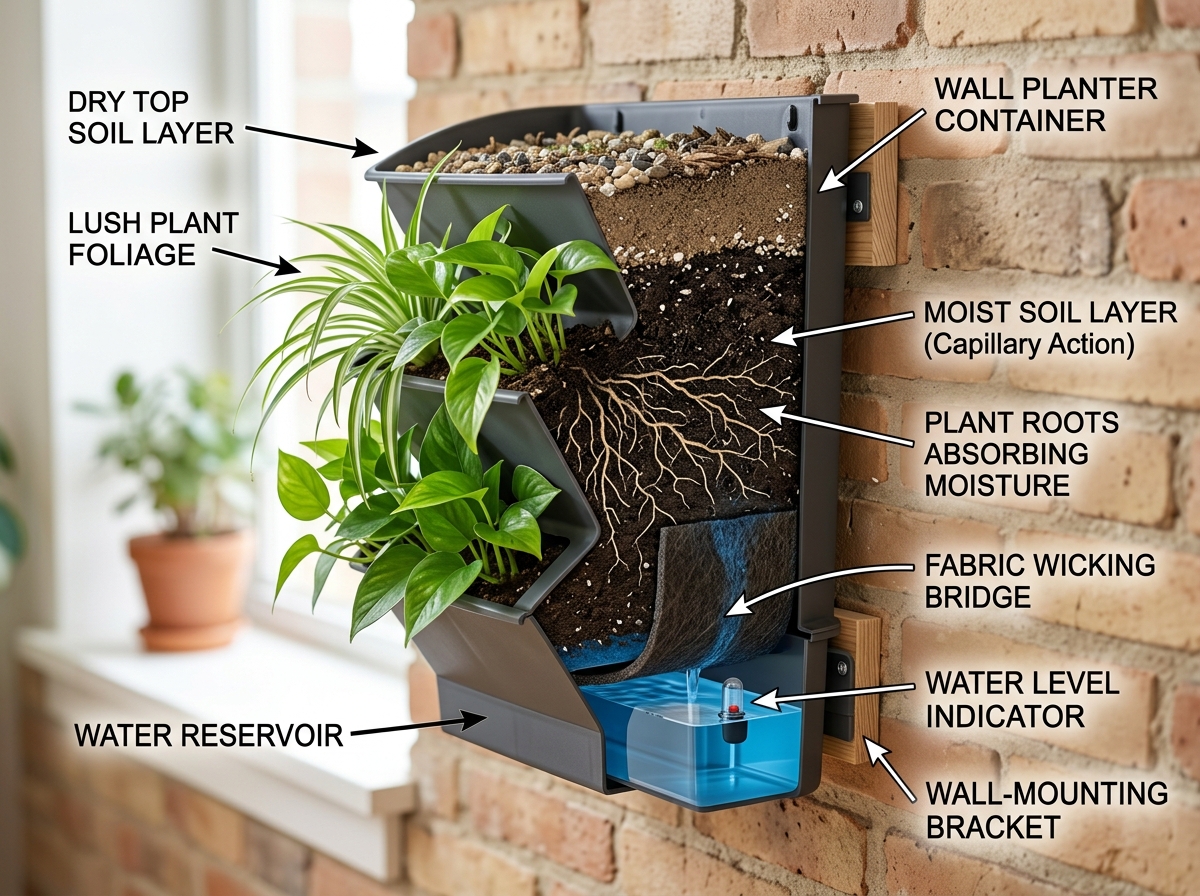
At its heart, a diy self watering wall planter relies on sub-irrigation. Instead of pouring water onto the top of the soil (where much of it evaporates or runs out the bottom), we store water in a reservoir at the base.
This system uses capillary action—the same physics that allows a paper towel to “suck up” a spill. By creating a bridge between the water and the soil, moisture travels upward as the plant’s roots consume it. This creates a consistent moisture level that traditional pots simply can’t match.
One of the biggest perks we love is nutrient supply. In a standard pot, every time you water, you wash nutrients out of the drainage holes. In a self-watering system, the nutrients stay locked in the “closed” environment, lasting up to 4 months in some setups. Plus, because the top layer of soil stays relatively dry, you’ll see a massive reduction in weed germination.
The Science of Wicking and Reservoirs
To make this work, you need a few key components:
- The Reservoir: This usually takes up 25% to 33% of the container’s total volume. For a standard 40-liter tub, that’s about 10 to 13 liters of water storage.
- The Wicking Mechanism: This is the “bridge.” We often use perforated pipes wrapped in fabric or small “wicking cups” filled with soil that sit directly in the water.
- Soil-less Medium: Regular garden soil is too heavy and will compact, leading to “anaerobic fermentation” (basically, your soil turns into a stinky, swampy mess). Instead, we use a potting mix—a blend of compost, coco coir, and perlite.
If you are curious about the vessel itself, check out our guide on the best pot for indoor succulents to see how different materials handle moisture.
Step-by-Step: Building Your DIY Self-Watering Wall Planter
Building your own system is surprisingly affordable. While professional living walls can cost anywhere from $100 to $1,000, we can build a highly effective diy self watering wall planter for under $50 using basic hardware store items.
Materials You’ll Need:
- A closed-bottom container (plastic garden tub, bucket, or large PVC pipe)
- PVC pipe (1-inch diameter for the fill tube)
- landscaping fabric
- Perforated drain pipe or small plastic pots (to create the air gap for the reservoir)
- Waterproof pond liner (if you’re building a wooden frame)
- Drill and a hacksaw
The Method:
- Prep the Reservoir: Place your perforated drain pipes or small upturned pots at the bottom of your main container. These should be about 3-4 inches tall.
- Install the Fill Tube: Cut your PVC pipe so it’s 2 inches taller than the container. Cut the bottom at a 45-degree angle (so water can flow out easily) and rest it on the bottom of the container.
- Drill the Overflow: This is the most important step! Drill a hole in the side of the container exactly at the top level of your reservoir pipes. This ensures that if you overfill, the excess water drains out instead of drowning your plants.
- The Fabric Barrier: Lay landscaping fabric over your reservoir pipes. This keeps the soil from falling into the water while allowing the wicks to pass through.
- Add the Wicks: Cut holes in the fabric and insert “wicking cups” (small pots filled with soil) or strips of microfiber cloth that reach the bottom of the reservoir.
For those just starting out, we have more indoor succulent care tips for beginners to help you keep your new green friends happy.
Creating a Wicking System for Your DIY Self-Watering Wall Planter
To get the best wicking action, we recommend a specific “wicking mix.” A 2:1 ratio of vermiculite to peat moss works like a high-tech sponge. It draws water up efficiently without becoming waterlogged.
| Feature | Standard Soil Pot | Hydroponic/Self-Watering |
|---|---|---|
| Watering Frequency | Daily/Every 2 Days | Weekly or Bi-Weekly |
| Growth Speed | Standard | Up to 3x Faster |
| Nutrient Retention | Low (leaches out) | High (stays in reservoir) |
| Maintenance | High | Low |
Low-Cost Alternatives for a DIY Self-Watering Wall Planter
If you’re on a “zero-dollar” budget, don’t worry! You can create a vertical chain of 2-liter soda bottles.
- Cut the bottom off one bottle.
- Invert it and nest it into the top of another bottle.
- Use a piece of cotton string or a strip of old t-shirt passed through a hole in the cap to act as the wick.
- Hang them vertically on a sunny wall.
Gravity does the work here—as you water the top bottle, the excess drips down to the next, creating a self-sustaining loop. This is a great way to try out a DIY hanging succulent terrarium project on a vertical scale.
Best Plants and Maintenance for Vertical Gardens
Not all plants are created equal when it comes to living walls. We’ve found that the best choices are plants with shallow roots and a love for consistent moisture.
Our Top Picks:
- Herbs: Basil, mint, and parsley thrive in these systems.
- Leafy Greens: Lettuce, spinach, and kale are perfect for kitchen walls.
- Trailing Plants: Pothos and heart-leaf philodendrons create that lush “jungle” look.
- Edibles: Alpine strawberries are fantastic for vertical spaces.
When planting, always use a peat-free potting mix. It’s better for the environment and provides the airy structure your plants need. If you’re specifically growing succulents, you might need to adjust your substrate; read more about the best soil for indoor succulents to get the mix just right.
Scaling Up to a Larger Vertical Garden Wall
Once you’ve mastered a single diy self watering wall planter, you might want to cover an entire wall. For larger installations (over 1.5 meters tall), manual filling becomes a chore. This is where automatic pumps and Arduino automation come in.
A simple 50L reservoir with a submersible pump can lift water to the top of your wall. Using a basic wall timer, you can set the system to water for 5 minutes, 3-4 times a day. This is essentially a vertical hydroponic system, and it can help your plants grow up to three times faster than traditional soil gardening.
Troubleshooting and Common Mistakes to Avoid
Even the “lazy” way has a few rules. Here are the most common pitfalls we see:
- Root Rot: This happens if your wicks are too efficient or your overflow hole is blocked. If the soil smells like rotten eggs, it’s too wet.
- Mosquitoes: Standing water is a mosquito spa. Always cover your overflow holes with a fine flyscreen.
- Algae Growth: If you use clear containers, light will hit the water and grow algae. Use opaque containers or paint your bottles to keep the reservoir dark.
- Salt Buildup: Over time, minerals from tap water and fertilizer can build up. Every few months, water the planter from the top until water runs out the overflow to “flush” the system.
To keep things running smoothly, check out our list of indoor succulent watering mistakes to avoid.
Secure Installation for Indoor and Outdoor Walls
A fully planted 1.5-meter PVC pipe can weigh over 30kg when the reservoir is full. You cannot rely on simple adhesive hooks!
- Outdoor: Use heavy-duty structural screws and metal brackets anchored into studs or masonry.
- Indoor: Always install a waterproof backing (like a sheet of PVC or a pond liner) between the planter and your drywall to prevent moisture damage.
Setting a perfect indoor succulent watering schedule is still important, even with a self-watering system, to ensure you aren’t refilling too often.
Frequently Asked Questions about Self-Watering Walls
How often do I need to refill the water reservoir?
In the heat of summer, a 40L system typically needs a refill once a week. In the winter or indoors, you can often go two to three weeks between top-ups. The best way to check is to use a “dipstick” (a thin piece of wood) down your fill tube or install a simple float indicator.
Can I use a self-watering system for an edible herb garden?
Absolutely! In fact, herbs like basil and mint prefer the consistent moisture of a diy self watering wall planter. Just ensure all the plastics you use are food-safe (look for the recycling numbers 2, 4, or 5).
How much does it cost to build a DIY system?
You can build a recycled bottle system for $0. A more robust wood-and-liner box or a PVC pipe system usually costs between $20 and $50. This is a massive saving compared to commercial kits that often start at $150 for a single panel.
Conclusion
At Opcion Rural, we believe that gardening shouldn’t be a chore—it should be a creative outlet that brings life into your home. Building a diy self watering wall planter is the ultimate “lazy” hack for a thriving garden. It saves water, saves space, and most importantly, saves your plants from the occasional bout of forgetfulness.
Whether you’re upcycling soda bottles or building a high-tech automated herb wall, the principles are the same: give the plants a steady drink, and they’ll give you a beautiful, lush home.
Ready to transform your space? Start your next creative project at Opcion Rural and let’s get growing!
