
Why Good Succulent Growing Tips Can Make or Break Your Plants
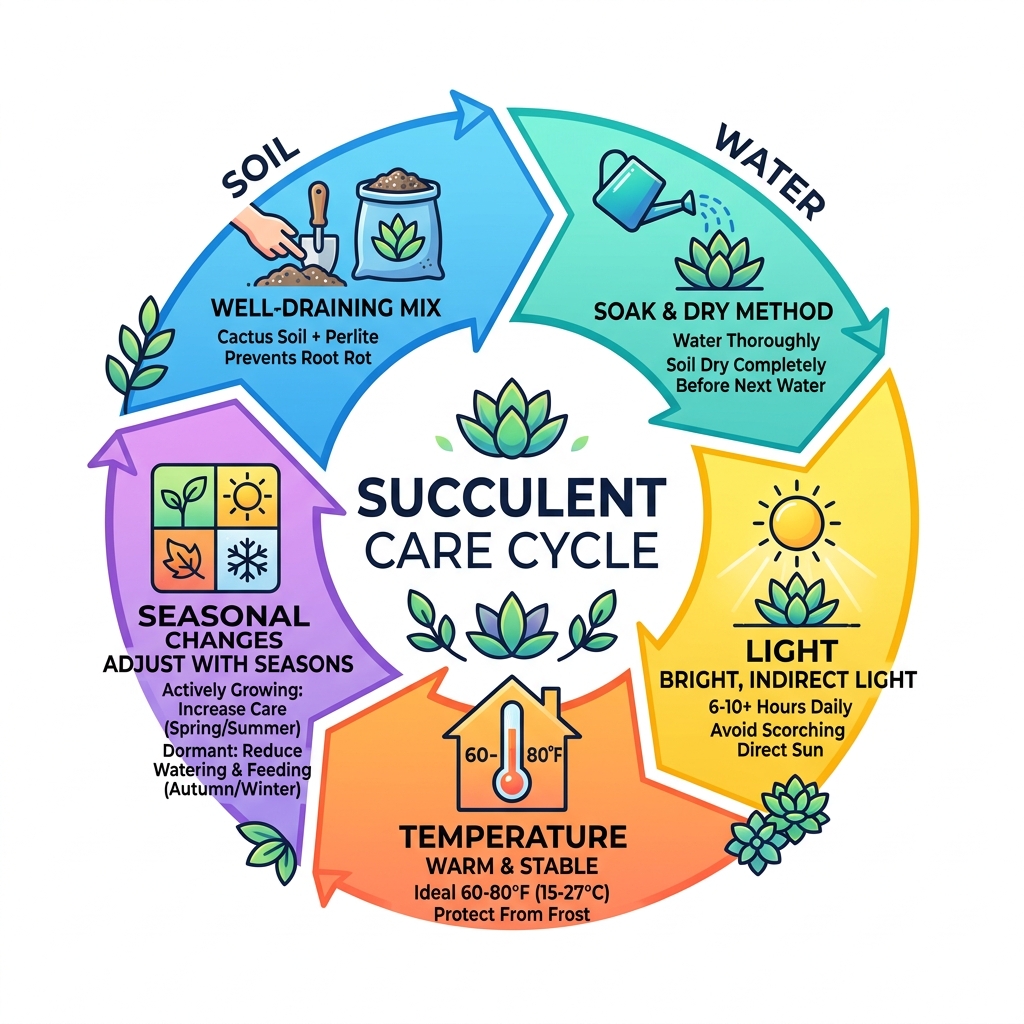
Succulent growing tips every beginner needs to know, fast:
| Care Factor | What To Do |
|---|---|
| Soil | Use a gritty, fast-draining mix (cactus mix + perlite) |
| Watering | Soak thoroughly, then let soil dry completely before watering again |
| Light | Bright, indirect light for most varieties (6-10+ hours) |
| Temperature | Keep between 60-80°F indoors |
| Pot | Always use a container with drainage holes |
| Fertilizer | Light feeding in spring and summer only |
| Pests | Check regularly for mealybugs and spider mites |
Succulents have a reputation for being nearly impossible to kill. And yet, overwatering alone wipes out more of these plants than almost any other cause.
The good news? Once you understand a few core principles, growing healthy succulents is genuinely straightforward — even in a small apartment with limited natural light.
Succulents are plants that store water in their thick, fleshy leaves or stems. That built-in reservoir is what makes them so forgiving of neglect. But it also means they’re highly sensitive to too much water and poor drainage — the two most common mistakes new growers make.
Whether you’re tucking a tiny Echeveria into a teacup or building a full indoor succulent arrangement, the same fundamentals apply. This guide covers everything you need: soil, water, light, temperature, propagation, pest control, and variety selection.
Understanding Succulents vs. Cacti
One of the most frequent questions we encounter at Opcion Rural is: “Is my cactus a succulent?” The short answer is yes! In botany, all cacti are succulents, but not all succulents are cacti. Think of “succulent” as a job description rather than a family name. It describes any plant that has evolved to store water in its leaves, stems, or roots to survive arid conditions.
These plants are known as xerophytes. While they share the goal of water conservation, their methods differ. Most succulents use their thick, fleshy leaves as storage tanks. Cacti, on the other hand, are a specific family (Cactaceae) that typically stores water in thickened stems and has replaced leaves with spines to reduce water loss and provide defense.
| Feature | Most Succulents | Cacti |
|---|---|---|
| Water Storage | Leaves, stems, or roots | Primarily stems |
| Leaves | Usually thick and fleshy | Usually absent or modified into spines |
| Areoles | Absent | Present (small bumps where spines grow) |
| Origin | Worldwide (deserts to rainforests) | Primarily the Americas |
It is also important to distinguish between desert species and rainforest species. While most succulent growing tips focus on desert dwellers like Echeveria, rainforest cacti (like the Christmas Cactus) actually prefer higher humidity and dappled light.
Identifying Your Plant Type
Knowing exactly what is sitting on your windowsill is the first step to success. If you aren’t sure where to start, check out our guide on How to Identify Succulent Types. For those who love the classic rose-shaped look, our Echeveria Care Guide for Beginners is a must-read. If you are working with limited space, you might prefer Mini Succulents for Indoor Gardening, which stay small and manageable for desk setups.
Essential Succulent Growing Tips for Soil and Potting
If there is one “secret” to succulent success, it is the soil. In their native habitats, these plants often grow in “weathered soils” that are very low in organic matter (humus) and high in minerals like sand and gravel. Using standard potting soil is a recipe for disaster because it holds onto moisture for too long, essentially suffocating the roots.
We recommend a mix that is roughly one-third organic material (like coco coir or peat-free potting soil) and two-thirds mineral material.

Key components for a “gritty” mix include:
- Pumice or Perlite: These create air pockets and ensure fast drainage.
- Coarse Sand: Not play sand (which is too fine), but builder’s sand or horticultural grit.
- Lava Rock or Slate Chips: Great for adding weight and structure.
For a deeper dive into creating the perfect environment, see our articles on the Best Soil for Indoor Succulents and the Best Pot for Indoor Succulents. Generally, unglazed terracotta pots are the gold standard because they are porous, allowing the soil to “breathe” and dry out faster. Most importantly, your pot must have a drainage hole. Without one, water pools at the bottom, leading to the dreaded root rot.
Repotting and Root Health
Succulents don’t need frequent repotting; in fact, many thrive when slightly root-bound. However, you should refresh the soil every year or two to prevent mineral salt buildup from tap water. When you do move your plant, choose a pot only 1 to 2 inches wider than the root ball.
Follow our Repotting Indoor Succulents Step-by-Step guide to ensure you don’t damage the delicate root system. For more general advice, our Indoor Succulent Care Tips for Beginners covers how to handle spiny plants safely using folded newspaper or thick gloves.
Mastering the Soak and Dry Watering Method
Forget everything you know about watering “a little bit every day.” Succulents hate “sips.” In the wild, they experience long droughts followed by torrential downpours. We want to mimic that in our homes using the “Soak and Dry” method.
- Soak: Pour water onto the soil (not the leaves!) until it runs freely out of the drainage hole.
- Dry: Wait. Do not water again until the soil is bone-dry all the way through. You can check this by sticking a wooden skewer into the pot; if it comes out clean and dry, it’s time to water.
Bottom watering is another professional trick. Place your pot in a tray of water and let it “wick” moisture up through the drainage hole for about 30 minutes. This ensures the entire root ball gets hydrated without getting water trapped in the plant’s rosette, which can cause rot.
Avoid these Indoor Succulent Watering Mistakes to Avoid to keep your plants from turning mushy. You can also establish a loose Indoor Succulent Watering Schedule, but remember: always let the plant tell you when it’s thirsty. Shrivelled or wrinkled leaves are a sign of thirst; yellow, translucent leaves mean you’ve gone too far with the watering can.
Seasonal Watering Adjustments
Your plants’ needs change with the seasons. During the active growing months (spring and summer), you might water every 10–14 days. However, in winter, most succulents enter a dormancy period. Their metabolism slows down, and they need significantly less water — perhaps only once a month.
Learn more about Indoor Succulent Care During Winter to prevent winter rot. If you are a naturally “forgetful” gardener, look for Indoor Succulents That Need Little Water, such as Sansevieria (Snake Plants) or Zamioculcas zamiifolia (ZZ Plants).
Optimizing Light, Temperature, and Humidity
Light is the fuel for your succulent’s growth. Most varieties need at least 6 to 10 hours of bright light daily. Indoors, a south-facing window is usually the best real estate. If your plant starts leaning toward the glass or stretching out (a process called etiolation), it is literally begging for more sun.
However, be careful with “direct” sun. Intense, magnified heat through a window can actually scorch the leaves, leaving permanent brown scars. Aim for “bright indirect light” — a spot that is very bright but where the sun’s rays don’t hit the leaves directly for the entire day.
For temperature, succulents are quite comfortable in the same range humans prefer: 60-80°F. They can handle cooler nights (down to about 45-50°F), which can actually help trigger flowering in some species. Humidity is rarely an issue indoors, as succulents prefer the dry air found in most homes. Avoid keeping them in bathrooms or kitchens where steam can lead to fungal issues.
Check our Sunlight Requirements for Indoor Succulents and our Indoor Succulent Humidity and Temperature Guide for specific environmental targets.
Managing Environmental Stress
Plants aren’t just decor; they are living things that react to their surroundings. To ensure Tips for Indoor Succulent Longevity-2, we recommend rotating your pots a quarter-turn every week. This ensures all sides of the plant get equal light, preventing that “lopsided” look.
Also, consider Seasonal Care for Indoor Succulents. If you have a balcony or patio, your succulents will love a “summer vacation” outdoors. The increased air circulation and natural rainwater (which is full of minerals and oxygen) can lead to a massive growth spurt. Just be sure to transition them slowly to prevent sunburn!
Propagation and Fertilizing Techniques
One of the most rewarding parts of growing succulents is that they are incredibly easy to “clone.” You can start a whole new collection from just a single leaf or a stem cutting.
- Leaf Cuttings: Gently wiggle a leaf off the stem (it must be a clean break!). Let it sit on a dry paper towel for a few days to callus over. Once callused, place it on top of some succulent soil and mist occasionally until tiny pink roots and a “baby” plant appear.
- Stem Cuttings: If a plant gets too tall, snip the top off, let the cut end dry for 3–5 days, and then stick it straight into the soil.
- Offsets: Many succulents, like Sempervivum (Hens and Chicks), produce “pups” or suckers. You can simply snip these off and pot them up separately.
When it comes to feeding, succulents are light eaters. Over-fertilizing can lead to weak, leggy growth. We recommend using a balanced liquid fertilizer (like a 10-10-10 or 15-15-15) diluted to half or quarter strength. Only fertilize during the growing season (spring and summer), roughly once a month.
Learn the specifics in our guides on How to Fertilize Succulents Indoors and How to Propagate Succulents Indoors.
Propagation and Fertilizing: Pro Succulent Growing Tips
For the best results, look for fertilizers with a slightly higher phosphorus count to encourage root development and flowering, rather than just leafy growth. If you are struggling with cuttings, a tiny dab of rooting hormone can speed things up, though it’s rarely necessary for succulents.
Easy-to-propagate varieties:
- Jade Plants (Crassula ovata)
- Sedum (Stonecrop)
- Echeveria
- Graptopetalum (Ghost Plant)
Troubleshooting and Variety Selection
Even with the best succulent growing tips, problems can arise. The most common issue is etiolation — when your plant stretches out and looks “leggy.” This is a permanent change to the stem, but you can fix it by “beheading” the plant and replanting the top rosette.
Pests are another hurdle. Mealybugs look like tiny bits of white cotton in the crevices of your plant. If you see them, act fast! You can spot-treat them with a cotton swab dipped in 70% isopropyl (rubbing) alcohol. Aphids and spider mites can often be blasted off with a sharp stream of water, followed by an application of neem oil.
If you notice leaves falling off, check our guide on How to Prevent Succulent Leaves from Falling. If your plant has already become too tall to manage, learn How to Prune Indoor Succulents to restore its shape.
Troubleshooting and Maintenance: Expert Succulent Growing Tips
To keep your plants looking “Pinterest-perfect,” regular maintenance is key. Dust the leaves with a soft paintbrush so they can photosynthesize efficiently. If you are dealing with a “stretcher,” read up on Preventing Succulent Stretching Indoors Practical Tips and Tricks.
Many Beginner Mistakes in Succulent Care come down to choosing the wrong plant for the wrong place. If your home is naturally dim, don’t fight nature — choose a low-light specialist!
Top Low-Light Succulents:
- Snake Plants (Sansevieria)
- ZZ Plants
- Haworthia (Zebra Plant)
- Gasteria (Ox Tongue)
Choosing Varieties for Your Environment
Matching the plant to your lifestyle is the ultimate pro tip. If you have a dark apartment, check out the Top Succulent Varieties for Low Light. For the busy professional, Low Maintenance Indoor Succulents and Easy Succulent Types for Office Desks offer beauty without the high-stress care requirements.
Frequently Asked Questions about Succulent Growing Tips
How often should I water my succulents?
There is no “one size fits all” answer, but generally, every 10–14 days in summer and once a month in winter. The golden rule is to always check the soil; if it isn’t dry at least two inches down, don’t water!
Why is my succulent growing tall and thin?
This is etiolation, caused by a lack of light. Your plant is physically stretching to try and find a light source. Move it to a brighter window or consider adding an LED grow light to your setup.
Do succulents need special fertilizer?
They don’t strictly need specialized “cactus food,” but they do need a balanced fertilizer diluted to half-strength. Avoid high-nitrogen fertilizers unless you want very rapid, weak growth.
Conclusion
Growing succulents is an invitation to slow down and observe the quiet beauty of nature. At Opcion Rural, we believe that blending art, nature, and creativity is the best way to build a home ecosystem that brings you joy. Whether you are starting with a single jade plant or planning an elaborate terrarium build, these succulent growing tips will give you the foundation you need to succeed.
Ready to dive deeper into creative gardening? Start your creative succulent journey with Opcion Rural and explore our DIY guides designed to make rural living and nature-inspired projects accessible to everyone. Happy planting!
