The "Lost Phone" Conversation Before It Happens
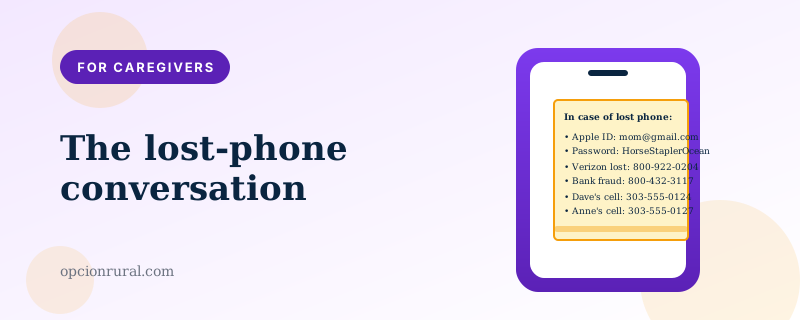
A phone gets lost. It happens to almost everyone eventually. For most adults the moment is irritating but manageable — you reach for the laptop, sign in to Find My, locate the phone, lock it, call your bank, get a replacement SIM the next day.
For an older parent whose phone is the central tool of their day, who isn't sure where their Apple ID password is written down, who can't remember which bank to call without their contacts app, who is panicking — the experience is dramatically worse. And it tends to fall to the adult child to walk them through it from far away.
The conversation that prevents most of the bad version of this experience takes about fifteen minutes and should happen before any phone is lost. Below is what to talk through.
What you're doing and why
The framing matters. You're not predicting catastrophe. You're putting a note inside a kitchen cabinet so future-you and future-them don't have to figure it out under stress. It's the same logic as the smoke detector and the fire extinguisher: you don't expect to need them, you have them anyway.
If your parent is resistant — "I never lose my phone" — point out that it's not really about losing it. It's about the day it falls in the toilet, the day it stops working without warning, the day they leave it on the kitchen counter at the daughter's house an hour from home. Those days happen, even to people who never lose anything.
The four pieces of paper
By the end of this conversation, four things should exist on actual paper, in a place both you and your parent know about.
Their Apple ID or Google Account email address and password. The single most important piece. Without this, recovering anything is dramatically harder. The password should be the actual current password, written legibly, on the paper.
If your parent is uncomfortable writing the password down (some people are), the compromise is: write a clear hint that you would understand but a stranger wouldn't. "Three words plus the year of grandpa's birth plus exclamation point." Better than nothing.
The carrier's lost-phone number. Verizon's, AT&T's, T-Mobile's, or whichever regional carrier your parent uses. Not the general customer service number — the specific 24-hour lost-phone line. The number is on the carrier's website; look it up now and write it down.
The bank's fraud line. The number on the back of the parent's debit card. Write it down separately so they don't have to find the card under stress.
Their own phone number, your phone number, and one other family member's phone number. Sounds obvious. Without the phone they've memorized none of these. Many adult children's numbers haven't been dialed by their parent in years because they're stored in Contacts.
Where to put it
Not the front of the refrigerator, where anyone walking through the house can see it. Not a desk drawer, where it gets lost in receipts.
Two places that consistently work:
Inside the door of a cabinet that's used daily — the cabinet where the cereal lives, the cabinet where the dish soap is kept. Tape the paper to the inside of the door. They will see it every day; they will see it again on the bad day.
In a small envelope inside the freezer, behind the ice cube tray. This is a folk technique used by plenty of older households — dust-free, fire-resistant, immediately findable, and not somewhere a casual visitor would think to look. Strange but effective.
The Find My / Find My Device test
While you're with your parent in person, do the test together once. Open the Find My app (iPhone) or visit android.com/find on the laptop (Android). Make sure it shows the parent's phone on the map. Make sure both of you know how to use it.
On the same visit, add your phone to their Find My family so you can also locate their phone from your own device in an emergency. This requires them to actively opt in — it's a small but real grant of access to their location. Talk through it. Many parents are fine with it specifically for lost-phone scenarios.
On Android, an equivalent feature exists but requires both phones to be Android and signed into compatible Google accounts. The Family Link app handles it.
What to do on the day
Three sentences your parent should be able to say out loud without looking at notes. Walk through them together until they're easy:
"I have lost my phone." (Said to the carrier, to the bank, to you.)
"My phone number is [their number]. My carrier is [their carrier]."
"I need to lock the phone, suspend my line, and put a hold on my cards."
That's the whole emergency procedure. Three statements, in any order, said calmly. The carrier and bank do the rest.
The thing your parent will actually do first
They will call you. Plan on it. The hardest part of being the adult child in this situation is not what's on the phone — it's being the calm voice on the other end of the call. Five minutes of "okay, breathe, we'll figure this out together" does more good than any technical step you'll take in the next hour.
If you've had the conversation in advance, the call is shorter because the paper exists and you both know what it says. If you haven't, the call lasts ninety minutes and ends with one of you hunting through the parent's email inbox trying to find an old Apple receipt that has the Apple ID on it.
The conversation is the kindness. The procedure is just paper.
One last thing
Have this conversation about your own phone too, with your spouse or your closest sibling. The day-after-tomorrow when you lose your own phone — you will — you'll be grateful that someone else knows where your kitchen cabinet note is.
A typical setup: the note taped inside the cabinet under the coffee machine, with one other adult in the household knowing it's there. Most people never have to use it. The next phone will eventually go missing, though, and on that day the cabinet note is the difference between an annoying afternoon and an awful one. The fifteen minutes that put it there are one of the most efficient uses of preparation a household can make.
Written by Justin Lowen. Last verified 15 June 2026.